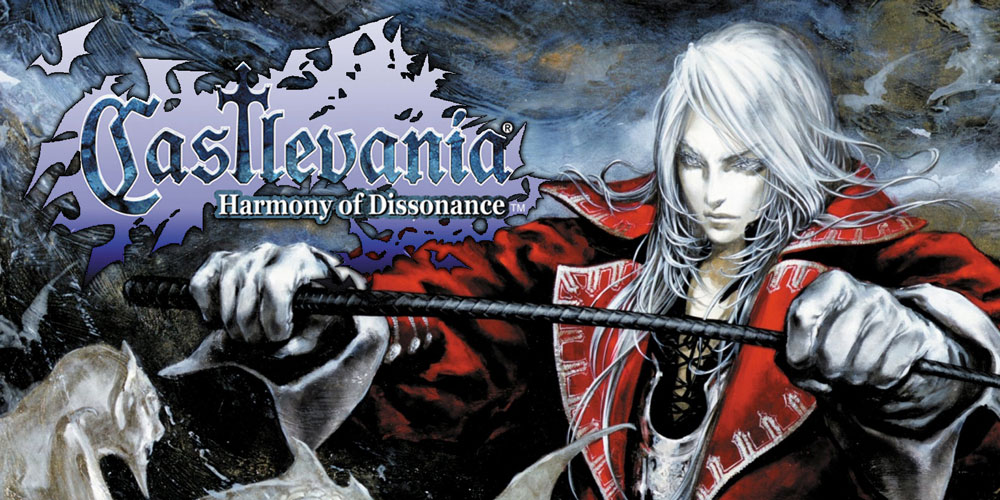
I think my reasoning is sound, though, because the game I played was Harmony of Dissonance for the GameBoy Advance. Now, if you're a longtime fan of the Castlevania franchise --and I assume you are since you're reading this and following the video series-- you'll recognize this game as one of the lesser siblings to some of the other handheld games in the series like Aria of Sorrow and Dawn of Sorrow. That's an assessment that's not really unfair, which I suppose I'll get to in a second. What makes it worth talking about, though, is its placement in the timeline of the franchise's releases. I'll get to that, too.
My own history with HoD is pretty mundane. It was released on the GameBoy Advance in 2002. I was 22 at the time, and since I bought a GBA specifically for 2001's Castlevania: Circle of the Moon (a game I contend is unfairly maligned), the purchase of the next game in a franchise I really, really like was a foregone conclusion. Funny enough, though, that's really all I can remember. I can tell you with resolute clarity when I got Circle of the Moon because I was flat broke, waiting tables at a fucking Chili's, and had made a conscious decision to spend money on entertainment rather than food and rent for the next several weeks. I can also clearly recall being in a Target in Bowling Green, OH just as I was transitioning out of the bubbling stream of college life into the hell bog of post-undergrad with my then-girlfriend hunting all over for a copy of HoD's followup, Aria of Sorrow. She was heckling me the whole time. It was not very charming of her. So, now that I'm reflecting on it, I can't tell you why, for the life of me, I don't remember playing this game.
What I can tell you, though, is that it's the portable Castlevania I've played the most, and again, I'm really not sure why. I mean, sure, I've got 100% saves on both of my Circle of the Moon and Aria of Sorry carts and have picked at them again over the years here and there, but I have three, count 'em, three 100% saves on HoD, and I had to actually delete one to start a new game. I don't remember loving this, or any other handheld Castlevania game that much to completely run the table on it three (now four) times, so what gives? I think I just used this as my long flight video game for a long stretch, maybe because it felt easier than the other games at the time. I can conjure up some ephemeral knee-jerk feelings of disappointment with it over the years, but that's about as far is it goes. Judging by recent events, that seems accurate right now.
But even though the game made almost zero impression on me, it's been on my mind a lot lately. Since making the Annotated Symphony of the Night videos and digging into the minutia of both the series and its creators, I made sort of a point to basically cease all thought regarding the further Castlevania games post-Symphony like I was partitioning off a room in my house or something. However, unless your name is Tyler Durden, people don't really do that, and as I was going through some of the cut content from Symphony and re-reading interviews with Toru Hagihara and Koji Igarashi (the game's co-directors), I couldn't help but ponder what direction they (mostly Igarashi) took the series after what they had learned making Symphony.
I wonder about the development of Symphony often, and any other game that's such a resounding critical success, really. Do they know that they're making a masterpiece? Honestly, I don't think most developers do; judging by how often the team says that some things "barely made the game" and how others "barely worked until just before the end," it seems logical that, like all video game development, that it was spectacular that the whole thing got finished and was working in a fair state. The fact that it was good, if not great was basically a small miracle. After all, this was a point in game development before copious focus testing and extensive Q/A, so it was a race against time to get the thing out the door (and they even convinced Konami to delay it for them while they continued to work on it, which doesn't sound like common practice at the time --probably because the publisher didn't give a shit about it compared to the other Castlevania game also in development). Obviously, some things work in development while others don't, and it's ok to assume that one learns quite a bit about game design and production --even if you've already shipped games in the past-- while working on a project. Bearing all of this in mind, you would infer that Harmony of Dissonance would have been not only a superb video game, but superior to Symphony of the Night.
But it wasn't. Even if we were judging the game on it's own merits, it's certainly not something awful (for a video game, for a game on the GBA, or even a game in the Castlevania catalog), but the added weight of both it's immediate and deep past doubles down its status as a disappointment. Harmony is a mediocre game. Worse; there's no reason for that whatsoever.
For context, let's talk about the GameBoy Advance and Circle of the Moon. Plenty of smarter people than me have spoken about the GBA's history, so in sum, it was a console that Nintendo developed years before they actually released it because, well, they didn't have any competition for a GameBoy that was already stomping every other handheld on the market. The thing was inexpensive to manufacture and housed juggernaut franchises like Pokemon. By the time the GBA actually did get set free in 2001, the parts were practically off-the-shelf and it was running on a processor that most seasoned developers knew how to tease in their sleep. Castlevania: Circle of the Moon was a launch title. Wait, no; CotM was a hell of a launch title. While of course lacking a bit of the depth of its predecessor, it was, in practical terms, Symphony of the Night on the go. But its problems were emblematic of the GBA in one fell swoop: it was extremely dimly lit, so it was almost impossible to see without a proper light source, and the sound chip was just this side of terrible. It was also a Castlevania game made by guys that weren't stewarding the franchise. Apparently, this was a huge problem.
So the task for the followup was twofold: First, it would be controlled by Iga, and would bring the artistic know how of the man that already gave us one of the best video games ever. Second, it would attempt to solve some of the first game's technical failings while still operating within the confines of what the GBA could actually do. One of those things worked, and even then, it comes with an asterisk.
But what works was an easy fix. CotM had a dark, morose color palette of hunter greens and burnt browns alongside the dark gray corridors. Harmony went all the way to the other side of the color wheel for bright reds and blues to brighten the visuals and alleviate the strained eyes that fought with the GBA's lack of a back-lit screen. As an artistic choice, it's fine, but boring. Whole chunks of the castle are lifeless and empty. Backgrounds have very little quality outside of the spots with obvious graphical gimmicks to make everything easier to see, but it makes the game feel underpopulated and sparse. The redundancy of the colors actually gets old pretty quickly, too.
This just picks at the scab of the bigger problem --the overall design. Too much is borrowed from Symphony, and not enough of it was thought through. Wisely, Harmony drops the pretense of a "secret" second castle to explore and makes it a plot point early on, which is a no-bullshit attitude I appreciate (especially in a game meant to be mobile). The problem is that actually navigating through both castles is an absolute nightmare. Rooms that warp you from one castle to the next mostly take you to the opposite side of the map from wherever you started, and since you're covering the exact same area (just with different enemies and a changed color palette), you're constantly checking your map to see where you are and where you're going, which ruins any kind of intuitive flow that the game may have. I can see that the design philosophy was to basically have you cover one side of one castle, then warp to the other side of a second castle, and then to figure out how the two meet in the middle was a fine choice on paper, I really do. But there's an over-reliance on backtracking here that's a conceit of the second castle, which is a rut that Iga's team fell into too quickly after it worked the first time in Symphony.
Actual traversal works even worse. While I can give it credit for re-implementing the dashes and slides that were taken out of the admittedly stump-footed Circle of the Moon, the need to explore old areas again and again for clues to the next location to uncover or hidden item to collect to finish the game is really hurt by the lack of actual warping for speedy travel throughout the castle. Again, I'm calling this a problem because there's double the amount of ground to cover. Once you have enough abilities to move more freely about the castles, it's a total slog to go from one to the next to double check if you missed something or maybe map that one room you couldn't reach before. Yes, metroidvania games by and large have this problem, but at least Symphony had ways around it, and I can't fathom how an Iga-produced game in this series would drop those mechanics with so much area to explore.
What's weird is that the actual construction of the castle exacerbates the problem, because most of the rooms are redundantly sized, and the few more open areas are only that way insomuch as that platforms and corridors bottleneck you back to a more comfortable size. I know that sounds weird, but since they ditched the ability from the previous game to fly wherever you feel like, the vast majority of the castle is replete with platforms to jump on and ceilings that cramp the area. It always feels like you are confined and not set free in a living, breathing location. Many of the more "open" areas actually seem claustrophobic, and it robs some of the exploration of the joy of discovery. Boss encounters are just as bad as they all take place in rooms of exactly the same size as each other, and practically all of them are of similar physical makeup, making most easily routed and steamrolled with the appropriate weapon load out. Really, as long as you can read an attack coming, you can keep your distance in these tight locations and pound them from afar.
Its place in the scope of Castlevania history also seems odd and wrongheaded on further recent reflection. Now, I'm not a timeline or cannon psycho. I (mostly) don't give a crap about how this fits into that and who birthed who and what time-traveling head of cabbage repaired which dude's fridge or whatever. But since Symphony was a game that was originally supposed to put a period on the previous games of the franchise, the fact that it was a success put the other games in the series in a peculiar state. I mean, sure, we're dealing with fiction here, and campy fiction at that, so it's not like Iga couldn't shoehorn something new into the loosely defined state of Castlevania up to that point, but part of the design of Symphony was a protagonist that was different than in previous games to help redefine what those games could be. Rolling back to a whip-cracking Belmont was both reductive and ill-fitting.
Let me clarify: I'm paraphrasing here, but the older, level-by-level linearity of classic Castlevania games was defined by the Belmont family's movement ability; specifically, their lack thereof. Symphony, then, gave us a protagonist that was outside of that mold, and holy shit, was this guy agile! He could alter the trajectory of his jump and could equip various weapons with different attack lengths and speeds. Minor though it sounds, this stuff was a drastic tonal shift for these games. In circling back to a Belmont main character, Iga's team decided to try the best of both worlds, and there's something lost in the translation: Juste Belmont attacks in a methodical fashion like his predecessors, but has the otherworldly ability to float along in mid air like Alucard. This means that there's no commitment to any movement outside of a jumping attack, so other than just tanking enemies with attack after attack, there's no threat to zipping around foes and doing your worst to them. He feels almost too mobile, even though the whipping can feel at times slow, and the exploration-heavy design of these kinds of games works against combining what worked in previous games to how it shakes out here. It seems that this was something that Iga and his team figured out quickly, because most other franchise games spun back to the more Alucard side of things, or was rejiggered just enough to fit correctly for 2006's Portrait of Ruin for the DS.
Callbacks to previous games for Harmony also feel like dipping back in the well a bit too much here, too, but that might just be a matter of taste. After all, Iga and Hagihara crammed basically everything from previous franchise games into Symphony as a way to say farewell, but it feels particularly redundant here to revisit plot points of the first two Castlevanias when they were dealt with almost 20 years prior to this.
Harmony of Dissonance was not directed by Koji Igarashi, so there's a natural feeling that it's the fault of lesser creators (like Takeshi Takedo, whom actually did direct it). This is misplaced, I feel. Really, this is the Dark Souls II problem in reverse. In that game, series director Hidetaka Miyazaki took a back seat while other From Software employees guided the game to completion. When it was release, Dark Souls II was given the misguided resentment of fans because it wasn't helmed by the original creator. I'm not the first person to say this, but there's a fallacy here that one guy carries the weight of everybody on a game's development team, kind of like the extreme, zealous end of auteurism philosophy. Tons of people make video games. Yes, it might be the guidance of a singular vision to get them there, but that's a fluid thing, especially during active development. The point of Harmony of Dissonance, though, was to wipe the slate clean of Circle of the Moon; a non-canonical side project not blessed by the Castlevania team's newfound creative direction after Symphony of the Night. In fact, Konami did their best to get the old band back together from Symphony to right a ship that wasn't even that far adrift. The fact that this game was so sub par from this kind of talent, led by Iga, is downright strange.
As a footnote to a series so beloved, it's an odd artifact. As a video game, though, really, it's fine. I didn't even get to other failings like the ponderously terrible music (it sounds like an ICOM RPG at some points, which is weird and kind of cute but really just badbadbadbad), but heaping more blame on it takes away from the fact that it's a perfectly fair game. There are redundancies and bad design choices just dripping from this game, but you could do a lot worse in portable Dracula-killing than Harmony of Dissonance in the grand scheme of things (though, if you're going to pick one, you should probably just skip the baloney and play Aria of Sorrow). Maybe in another ten years or so I'll come back around to it to see if my views have changed. Since that's exactly what I did for a game I evidently barely remember, though, probably not.


