Here's some actual inside dope about the making of this episode: It went wildly out of control right after I picked up the Shield Rod. Let's talk about that first.
See, the Colosseum is a relatively circuitous area of the game, not necessarily a straight line. This is good from a design perspective, actually; the player will find themselves wandering around in similar, though not redundant (it's not that big of a level) locations sussing out the best ways to get the Form of Mist relic, which is on display behind an obstacle from the second they walk in. Do they stumble into the boss fight right away? Certainly possible since it's pretty close to the entrance. But for the sake of a video series like this, boss fights are good places to end episodes since you can easily put a period on things that way. That meant showing the majority of the location before jumping into the final showdown, which takes a little cartographic forethought.
Totally blew that. What you don't see is that I save the game after grabbing and explaining the Shield Rod --a holy object to most players that destroys the game-- and lose track of where I was and what direction I was going. Not that big of a deal since I can just edit stuff together, but I had to reset the game and start from that save room, losing video footage of actual item drops that I could point out. Lame. Worse, I went through the second run at a faster clip, which meant that I had to re-record some of the dialog to reflect that I had already passed some rooms by the time I could actually talk about them. From the standpoint of you, the viewer, I wonder if you're ok with that. Sure, some places mean that I have to just sit tight and blabber for a while, but in terms of less significant spots like the torture chamber where the Blood Cloak is found, it probably isn't that big a deal. Hmm.
What you can also probably glean from my voice in this one is that I'm sick, and have been for weeks. This may be something you care about very little because you have cold, black heart and don't really give a poo for my well-being. That's fine. For me, and the fact that I'm doing this whole thing for some perverse sense of posterity, I want to get these out the door in the best possible state they can be in, which means that I was trying to get better first. Since I have the cold that wouldn't die, though, I made the executive decision to just get it out the door. So there.
Anyway, enjoy episode 7. I'll map the rest of the library and probably move on to either Orlox's Quarters or the Underground Waterway next (probably the former).
Monday, December 5, 2016


Tuesday, November 29, 2016
Sorrow No More

I can't sit here and tell you that "I don't know how I got to this point," because that's both a stupid writer-y thing to say, and obviously false. The last 8 months or so of my life has been living Castlevania like one might live Buddhism, so the idea of playing some of the latter IGA-produced games was a logical next step. It is fair to say, though, that I didn't really think I would be doing it so soon into this whole odyssey. I guess after playing Harmony of Dissonance last month that I would try to hold out until the ASOTN series was much further along before going ahead with the later stuff. But, you know, there's a new Final Fantasy coming out tomorrow and I had some time to kill beforehand, so...
I mentioned before that I can recall buying Aria of Sorrow very clearly, and I wasn't making that up. What I didn't get into was how weird of a time in my life that was. Released in May of 2003 worldwide, I was six months removed from college at that point, and about to finish my first year of teaching at a middle school in northern Ohio; a job that terrified and delighted me. I was good at it, (I mean, I think I was), but was never sure if it was the right career path. Also, since I knew that I wasn't going to stay at this school next year --unilateral budget cuts meant a lot of teachers weren't returning that fall-- and deciding that I would move to Cleveland sometime in the summer after the school year ended, I was in a peculiar emotional place. Do I keep teaching after I move? Is it a good plan to leave the place where I grew up to be closer to my then-girlfriend? Am I doing the right thing at all, here?
In hindsight, all of that matters very little and a whole hell of a lot with equal weight. What immediately mattered in May of 2003, though, was that I had a lot of disposable income. Going from a perpetually broke college student to a person with even the meager salary of a first year school teacher was a dramatic lifestyle change. So, yes, when new video games came out that I wanted to buy, no longer was I forced to pine over them for weeks or months to eventually save the dough to purchase them or wait for a far off birthday or holiday gift. I could just walk into, say, a Target at 9pm, dig through a store, and drive home with a new Game Boy Advance cartridge. And that's what I did. It was great.
[Aside: You might also remember the last time I brought this up that my girlfriend, whom was happy to reap the benefits of this newfound infusion of 23 year-old semi-wealth, felt the need to heckle and judge me for this purchase. No, we didn't last.]
The battery memory on this Aria of Sorrow cart, then, tells me that I had completed the game in its entirety twice, with a middle file indicating that I had started the bonus Julius Mode and got bored with it at roughly 4 minutes and change. That makes sense. After playing Richter mode to hell and back in Symphony as a teenager and found that there really wasn't that much to it, I never put much stock into these extra modes, so I just sort of picked at them in subsequent games (though, this would change eventually. We'll get to that some other time). Maxim mode in Harmony of Dissonance was similarly messed with for a requisite 15 minutes or so, and this was no different. Yet this Julius mode file will remain on the Aria cartridge for some sentimental reason I can't really fathom now. I don't get it either. Let's just talk about the game.
The first thing that struck me all of these years later (aside from the cooler color palette as opposed to Harmony's more warm red and purple tones) was just how confident the whole game feels as compared to its predecessor. While still produced by Igarashi, Aria's director was Junichi Murakami, whom replaced Harmony's Takeshi Takeda, and the games fell noticeably different in scope from the opening cut scene. The graphics are clearer, the system mechanics are more intricately designed, and it feels as though IGA had either taken more of an active hand in development, or that he and whatever overlapping members of both games' teams learned plenty from their first experience with GBA hardware that they had a handle on things.
It really boils down to castle design. Gone were most of the empty rooms full of platforms in favor of level designs that were more Symphony-like, meaning open spaces for flight and plenty of breakable walls that lent to a sense of mystery that the previous game lacked. But it's not completely in-line with Symphony's best designs, though. As I play through Symphony for the Annotated series, the subtle ways the game directs you to the next destination are very meticulously placed. Some, like the Library Card in the Colosseum, are more overt, while others, like the Stopwatch subweapon in the Long Library right next the Form of Bat relic, take a bit more inference on the player's part to connect the dots, which is awesome. Aria only really does this once that I could tell, and that was right at the beginning of the game when Soma kills his first Peeping Eye enemy. If you're stupidly lucky, you might score the soul of this monster on your first time killing it, and if you find yourself equipping the soul right away, you'll quickly deduce that there's a hidden room behind a breakable wall in that same spot. This enemy placement was obviously purposeful, then. Very neat, but not enough as I didn't detect anything else in the game that gave me this same sense of direction, just the normal innate encouragement that I better map everything and just take mental notes of where to go after finding X ability.
I'm venturing to guess that this was done very intentionally. Aria, honestly, is a pretty short game, and now that the concept of two somewhat different castles from both Symphony and Harmony was becoming old hat, the conceit was wisely dropped in favor of a singular, more interesting area to conquer. How do you keep people from bulldozing the game, then, and give the player bang for their buck? Grinding. Tons of grinding. And worse (or, depending on your perspective, better, I guess), it's required grinding for 100% completion. If you're reading this, you probably already know full well about Aria's enemy skill collecting system. What you probably haven't really cared to put together is that it's not completely necessary to finish the game by mindlessly running in and out of rooms to respawn enemies to farm abilities. If you just want to run the game and get an ending, you can probably do it in 3-5 hours. Not a lot of time for a game back then (I can do Symphony in 3ish hours at 200+% completion, but that's because I know it backwards). If you really want to dig through every nook and cranny, you need to collect a few specific enemy powers to do so. Screw clever clues to guide you to the next destination, then. IGA and the team wanted you to spend hours killing mooks and experimenting with their powers. Roadmaps weren't necessary.
The trade-offs between Aria and it's predecessor, then make a whole lot more sense now that I'm writing them down. For one, Harmony is a much faster-moving game. Even though I feel that Aria can be shorter from an hour count perspective, actual castle-mapping crawls in comparison. There's no easy dash ability baked into the protagonist, and enemy soul abilities to speed things along are few and far between. This also feels intentional because with all of that grinding to be done, the game needs to set a certain sense of pace. It's honestly kind of a pain, but not nearly as much as Aria's less-favorable hit boxes on weapons. In the last several games (and this includes my recollection of Circle of the Moon, but I could be wrong), the point of animation that actually damage enemies is far more generous, so even though Alucard may be swinging a sword horizontally it will cut a monster directly above or below him. That's not the case for Soma in Aria of Sorrow. Weapons and the way they're wielded are now specific to where the attack lands in this game, and that takes a lot of getting used to. At least it did for me after such a steady diet of easy striking in other games.
What Aria has over the last several franchise entries, though (and this includes Symphony), is a satisfying sequence of endgame boss fights. The duel with Julius Belmont is tense and challenging, but completely fair. The final showdown to get the real ending is way more fun than I recall. Having ditched the usual last encounter with Dracula for plot reasons turned into a blessing in disguise.
But maybe Aria's biggest failing and smartest design choice is the soul collecting mechanic, and that's something that we can debate until we're blue in the face, but it doesn't really matter. Aria of Sorrow is a good GBA game insomuch is that it ditches things from Harmony that didn't work and replaced them with a better designed castle to explore with consequences to movement and combat. That's fine, and a fair enough evolution to what had become the formula for the series by this point. I've begun playing Dawn of Sorrow, but this hasn't happened in earnest yet. My guess is that it will be more of the same, and my memory of it is that it's exactly that. But compared to Harmony, a pretty good but by no means spectacular stepping stone, I'll take that any day of the weak.
Wednesday, November 16, 2016
Annotated Appendix: The Royal Chapel
This one was a pain, and I think it shows.
Not only were there delays on its completion (and more delays that personally hurt, which I don't want to get into), for some reason, this whole episode just feels... off to me. The muffled audio is probably a really good sign of that, and maybe I'm just being my own worst critic, but I just get this feeling that the seems are really showing in this ep. Maybe I'm paranoid, but I'd appreciate the feedback.
If there's an epicenter from which that paranoia spawns, though, it must be from the fact that this is the first section of the game where I have no direct developer commentary to pull from. The Entrance had tons of info online about it straight from the producer's mouth, and other locations had their own share of tidbits from people involved with the game here and there. The RC, though? Nope. I had to strip mine any shred of knowledge that I could via the Castlevania wiki and other internet sources. It's still good stuff, and all accurate to the best of my knowledge. Sadly, though, I couldn't just fly to Japan to get the game's directors to play the whole thing with me (the closest thing is the Double Fine Dev's Play video, which is referenced constantly anyway), so cool, in-depth dev history on specific locations is going to start becoming a little scarce.
I worry that I also shot my wad a little bit with the backtracking filler about magic use, but since people have complained --rightfully, I might add-- that I should be using it more often to get through the game, it was worth addressing because it will absolutely come up in the Colosseum video.
What all of this angst is getting at, I suppose, is that there's always going to be something interesting to say or point out about the game. I'm just worried that I've gone through the really fascinating deep knowledge because it all seemed front loaded. Maybe that should be your incentive to keep watching the videos, though. YOU NEVER KNOW, or whatever.
I'm also starting to kick around the idea of starting a Patreon for the channel for a few reasons. The first is to help me replace anything that might go south during this whole endeavor, like another disc if a meteor strikes or something and ruins my original, an OEM PlayStation 2 pad because all of this backdashing is certainly destroying a few buttons, or (God forbid) my laptop because it's already doing more than I should be asking of it. The second is that I was thinking of doing a video of some of the differences in the Saturn version to coincide the quieter moments in the inverted castle. I know I could just emulate that stuff, but again, I don't want to put any more undue stress on the PC than I have to. Part of me feels as though I should probably just buy a copy of the Saturn version to have around anyway, too. I don't know. Still tossing the idea around, so any opinions on that would be welcome, too.
Anyhoo, thanks again for watching.
Not only were there delays on its completion (and more delays that personally hurt, which I don't want to get into), for some reason, this whole episode just feels... off to me. The muffled audio is probably a really good sign of that, and maybe I'm just being my own worst critic, but I just get this feeling that the seems are really showing in this ep. Maybe I'm paranoid, but I'd appreciate the feedback.
If there's an epicenter from which that paranoia spawns, though, it must be from the fact that this is the first section of the game where I have no direct developer commentary to pull from. The Entrance had tons of info online about it straight from the producer's mouth, and other locations had their own share of tidbits from people involved with the game here and there. The RC, though? Nope. I had to strip mine any shred of knowledge that I could via the Castlevania wiki and other internet sources. It's still good stuff, and all accurate to the best of my knowledge. Sadly, though, I couldn't just fly to Japan to get the game's directors to play the whole thing with me (the closest thing is the Double Fine Dev's Play video, which is referenced constantly anyway), so cool, in-depth dev history on specific locations is going to start becoming a little scarce.
I worry that I also shot my wad a little bit with the backtracking filler about magic use, but since people have complained --rightfully, I might add-- that I should be using it more often to get through the game, it was worth addressing because it will absolutely come up in the Colosseum video.
What all of this angst is getting at, I suppose, is that there's always going to be something interesting to say or point out about the game. I'm just worried that I've gone through the really fascinating deep knowledge because it all seemed front loaded. Maybe that should be your incentive to keep watching the videos, though. YOU NEVER KNOW, or whatever.
I'm also starting to kick around the idea of starting a Patreon for the channel for a few reasons. The first is to help me replace anything that might go south during this whole endeavor, like another disc if a meteor strikes or something and ruins my original, an OEM PlayStation 2 pad because all of this backdashing is certainly destroying a few buttons, or (God forbid) my laptop because it's already doing more than I should be asking of it. The second is that I was thinking of doing a video of some of the differences in the Saturn version to coincide the quieter moments in the inverted castle. I know I could just emulate that stuff, but again, I don't want to put any more undue stress on the PC than I have to. Part of me feels as though I should probably just buy a copy of the Saturn version to have around anyway, too. I don't know. Still tossing the idea around, so any opinions on that would be welcome, too.
Anyhoo, thanks again for watching.
Thursday, November 3, 2016
Annotated Update

The newest episode is coming along a bit slower than previous videos, so I just wanted to drop a line and say that I haven't given up or anything and that The Royal Chapel will show up sometime next week.
Here's why: My normal routine sort of fell out of whack the last few weeks and that didn't offer a lot of time to get the voice recording finished. It didn't help that the script for the Royal Chapel is the longest one so far. In my last pass of edits to it, I just inserted another multi-paragraph section that's going to require even more voice work, and that's what's really slowed things down.
Outside of that, two large, unforeseen factors have eaten up my evening free time. One of them had to do with perennial losers the Cleveland Indians blowing a 3-1 series lead to give other perennial losers the Chicago Cubs a World Series victory. I have not had a lot of sleep, so I'll concede defeat here and say congratulations, Cubs fans. You really do deserve the win after such an absurd drought, but fuck you all the same.
The second thing was some nice, light freelance work, which was a nice change of pace. You can read here (my first published thing for Paste!).
Now, if you'll excuse me, I have a buttload of Iron & Wine to listen to while I sulk the day away.
Wednesday, October 12, 2016
Annotated Appendix: The Long Library
Hey, really quick...
(takes you by the hand)
(leads you down a flight of stairs)
(opens the door to a dark, grimy alley)
(whispers in your ear)
...Super Castlevania IV isn't very good.
Yes, this is my opinion, but yes, it is counter to the cultural narrative that surrounds such a long-running and well-loved series of games. Am I saying this just to be adversarial to popular opinion? Mmmmno; the entire world seems to love it, but it's not like some classic piece of art that's stood the test of time to become a bonafide masterpiece like, I don't know, For Whom the Bell Tolls or something. If that were the case, me saying that I don't like it is just being contrarian for it's own sake. I'll admit that it has such a pervasive feeling of fond remembrance, though, that it's coming close, but when it comes down to brass tacks and you feel the need to play through every Castlevania game prior to 1997, I'm going to get you good and drunk so you have no choice but to tell the truth, and I'll put 100/1 odds that you'll find it about as mid-tier in this series as most of the handheld entries (at best). This whole paragraph isn't meant to hold a finger in front of your nose and repeat that I'm not touching you, but if I get through to even one of you that Castlevania IV is overrated, I feel as though this holy mission has been worthwhile. I also think that the second Bloc Party record is every bit as good as the first (though, for totally different reasons). Fight me.
WAIT. That isn't to say that it's godawful by any stretch, and there has been a frustratingly large minefield of lousy Castlevania games in the past (The Adventure, I'm looking right at you). As most know, it was a launch title for the Super Nintendo in 1991 and did its best to shoehorn in eveything that what was under the SNES' hood as far as Mode7 programming tricks were concerned, but to the game's detriment. I've always found the pace to be strange and haphazard, and aesthetically gross to look at with its sort of marionette-style sprites. The difficulty is also all over the goddamn map, making some of the later levels downright impenetrable compared to what Simon runs into even five minutes earlier. However, and this is where I'll give its proponents their druthers, it's just experimental enough as a piece of the series to be interesting with the multi-angled whipping and slightly altered jumping physics. If anything, I absolutely love that Konami had decided to do a remake of the first Castlevania from the NES, while also (at least from my perspective) tossing in some of the quirks from the lesser known entries of the series like Haunted Castle and Vampire Killer, and is still better than both of those by a country mile. I've heard people say that it's something of an evolutionary dead end of a franchise that continued to grow, and that's a fair assessment. I don't think it's an unequivocal piece of shit, but I do not think it's all that great. But I'm glad it exists, I suppose.
Alas, this was what I needed to put myself through for the second time in six months last weekend when I realized --because I'm stupid-- that I didn't get nearly enough footage from C4 as I originally thought, which is why Episode 5: The Long Library went up on Monday this week as opposed to last Friday. The whole thing was done, but after extensive checking and copious swearing, I found that I had zero footage of the enemies that originated in the Super Nintendo mediocrity. Lucky for me and my sense of good taste that I could easily look up where the Une, Ectoplasm, and Spellbooks where and just use codes to start at those levels (also so I could get footage of the guy and his dog, which will make sense later). Anyway, Episode 5 is now a thing that can be consumed like the insatiably filthy savages that you are, you beautiful internet goofs. Go watch it.
As far as actual stuff going on in the video, this one was hard to make because of the Librarian alone. Since I'm probably never going back to this guy in future videos, I had to recount all of what he sells as the game goes forward and give enough time to say something interesting about them, but close to none of the stuff I mention is on his list of goods at such an early point in the game. It was a pain, but that's how it goes. Luckily, this episode was super straightforward, though, because there really isn't a lot of ground to cover without the form of bat. There was some dead air on the mic as I backtracked a bit, but like I said in an earlier Appendix, sometimes, there just isn't a way around that, unfortunately. Hopefully, the Royal Chapel will be better in that regard.
PS-I'm finally getting shit for my mispronunciations of certain words. I guess only one linguistics class from my undergrad just wasn't enough. One more step to Making It!
(takes you by the hand)
(leads you down a flight of stairs)
(opens the door to a dark, grimy alley)
(whispers in your ear)
...Super Castlevania IV isn't very good.
Yes, this is my opinion, but yes, it is counter to the cultural narrative that surrounds such a long-running and well-loved series of games. Am I saying this just to be adversarial to popular opinion? Mmmmno; the entire world seems to love it, but it's not like some classic piece of art that's stood the test of time to become a bonafide masterpiece like, I don't know, For Whom the Bell Tolls or something. If that were the case, me saying that I don't like it is just being contrarian for it's own sake. I'll admit that it has such a pervasive feeling of fond remembrance, though, that it's coming close, but when it comes down to brass tacks and you feel the need to play through every Castlevania game prior to 1997, I'm going to get you good and drunk so you have no choice but to tell the truth, and I'll put 100/1 odds that you'll find it about as mid-tier in this series as most of the handheld entries (at best). This whole paragraph isn't meant to hold a finger in front of your nose and repeat that I'm not touching you, but if I get through to even one of you that Castlevania IV is overrated, I feel as though this holy mission has been worthwhile. I also think that the second Bloc Party record is every bit as good as the first (though, for totally different reasons). Fight me.
WAIT. That isn't to say that it's godawful by any stretch, and there has been a frustratingly large minefield of lousy Castlevania games in the past (The Adventure, I'm looking right at you). As most know, it was a launch title for the Super Nintendo in 1991 and did its best to shoehorn in eveything that what was under the SNES' hood as far as Mode7 programming tricks were concerned, but to the game's detriment. I've always found the pace to be strange and haphazard, and aesthetically gross to look at with its sort of marionette-style sprites. The difficulty is also all over the goddamn map, making some of the later levels downright impenetrable compared to what Simon runs into even five minutes earlier. However, and this is where I'll give its proponents their druthers, it's just experimental enough as a piece of the series to be interesting with the multi-angled whipping and slightly altered jumping physics. If anything, I absolutely love that Konami had decided to do a remake of the first Castlevania from the NES, while also (at least from my perspective) tossing in some of the quirks from the lesser known entries of the series like Haunted Castle and Vampire Killer, and is still better than both of those by a country mile. I've heard people say that it's something of an evolutionary dead end of a franchise that continued to grow, and that's a fair assessment. I don't think it's an unequivocal piece of shit, but I do not think it's all that great. But I'm glad it exists, I suppose.
Alas, this was what I needed to put myself through for the second time in six months last weekend when I realized --because I'm stupid-- that I didn't get nearly enough footage from C4 as I originally thought, which is why Episode 5: The Long Library went up on Monday this week as opposed to last Friday. The whole thing was done, but after extensive checking and copious swearing, I found that I had zero footage of the enemies that originated in the Super Nintendo mediocrity. Lucky for me and my sense of good taste that I could easily look up where the Une, Ectoplasm, and Spellbooks where and just use codes to start at those levels (also so I could get footage of the guy and his dog, which will make sense later). Anyway, Episode 5 is now a thing that can be consumed like the insatiably filthy savages that you are, you beautiful internet goofs. Go watch it.
As far as actual stuff going on in the video, this one was hard to make because of the Librarian alone. Since I'm probably never going back to this guy in future videos, I had to recount all of what he sells as the game goes forward and give enough time to say something interesting about them, but close to none of the stuff I mention is on his list of goods at such an early point in the game. It was a pain, but that's how it goes. Luckily, this episode was super straightforward, though, because there really isn't a lot of ground to cover without the form of bat. There was some dead air on the mic as I backtracked a bit, but like I said in an earlier Appendix, sometimes, there just isn't a way around that, unfortunately. Hopefully, the Royal Chapel will be better in that regard.
PS-I'm finally getting shit for my mispronunciations of certain words. I guess only one linguistics class from my undergrad just wasn't enough. One more step to Making It!
Monday, October 3, 2016
Do You Know What Dissonance Means?
Last week, after taking stock of having four videos in the can and recording the voice for a fifth (which should be up sometime later this week), I decided to take a quick break from making Castlevania videos to... play another Castlevania game. Yes, this seems both redundant and a little dumb, and I think I actually heard your eyes rolling as you read this. That's ok! I also played a little bit of The Order 1886, but come on, you really don't to hear about that, right?
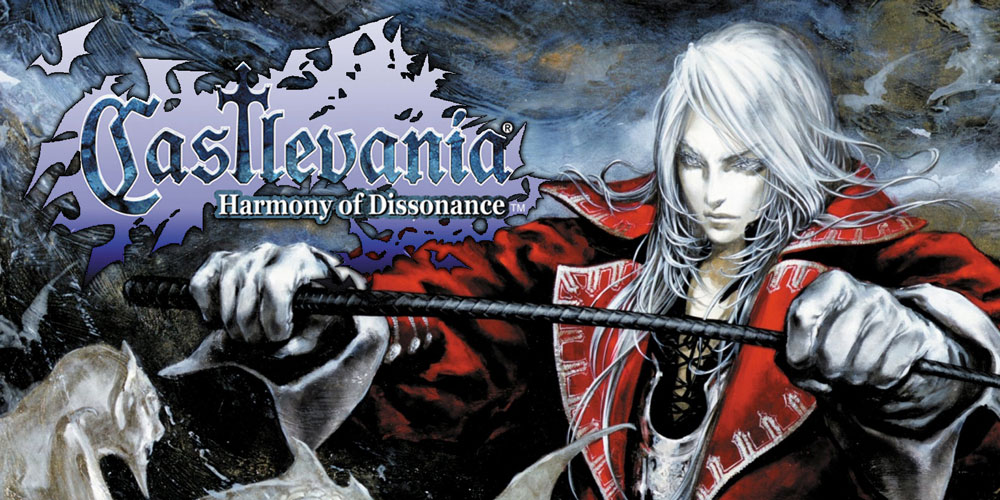
I think my reasoning is sound, though, because the game I played was Harmony of Dissonance for the GameBoy Advance. Now, if you're a longtime fan of the Castlevania franchise --and I assume you are since you're reading this and following the video series-- you'll recognize this game as one of the lesser siblings to some of the other handheld games in the series like Aria of Sorrow and Dawn of Sorrow. That's an assessment that's not really unfair, which I suppose I'll get to in a second. What makes it worth talking about, though, is its placement in the timeline of the franchise's releases. I'll get to that, too.
My own history with HoD is pretty mundane. It was released on the GameBoy Advance in 2002. I was 22 at the time, and since I bought a GBA specifically for 2001's Castlevania: Circle of the Moon (a game I contend is unfairly maligned), the purchase of the next game in a franchise I really, really like was a foregone conclusion. Funny enough, though, that's really all I can remember. I can tell you with resolute clarity when I got Circle of the Moon because I was flat broke, waiting tables at a fucking Chili's, and had made a conscious decision to spend money on entertainment rather than food and rent for the next several weeks. I can also clearly recall being in a Target in Bowling Green, OH just as I was transitioning out of the bubbling stream of college life into the hell bog of post-undergrad with my then-girlfriend hunting all over for a copy of HoD's followup, Aria of Sorrow. She was heckling me the whole time. It was not very charming of her. So, now that I'm reflecting on it, I can't tell you why, for the life of me, I don't remember playing this game.
What I can tell you, though, is that it's the portable Castlevania I've played the most, and again, I'm really not sure why. I mean, sure, I've got 100% saves on both of my Circle of the Moon and Aria of Sorry carts and have picked at them again over the years here and there, but I have three, count 'em, three 100% saves on HoD, and I had to actually delete one to start a new game. I don't remember loving this, or any other handheld Castlevania game that much to completely run the table on it three (now four) times, so what gives? I think I just used this as my long flight video game for a long stretch, maybe because it felt easier than the other games at the time. I can conjure up some ephemeral knee-jerk feelings of disappointment with it over the years, but that's about as far is it goes. Judging by recent events, that seems accurate right now.
But even though the game made almost zero impression on me, it's been on my mind a lot lately. Since making the Annotated Symphony of the Night videos and digging into the minutia of both the series and its creators, I made sort of a point to basically cease all thought regarding the further Castlevania games post-Symphony like I was partitioning off a room in my house or something. However, unless your name is Tyler Durden, people don't really do that, and as I was going through some of the cut content from Symphony and re-reading interviews with Toru Hagihara and Koji Igarashi (the game's co-directors), I couldn't help but ponder what direction they (mostly Igarashi) took the series after what they had learned making Symphony.
I wonder about the development of Symphony often, and any other game that's such a resounding critical success, really. Do they know that they're making a masterpiece? Honestly, I don't think most developers do; judging by how often the team says that some things "barely made the game" and how others "barely worked until just before the end," it seems logical that, like all video game development, that it was spectacular that the whole thing got finished and was working in a fair state. The fact that it was good, if not great was basically a small miracle. After all, this was a point in game development before copious focus testing and extensive Q/A, so it was a race against time to get the thing out the door (and they even convinced Konami to delay it for them while they continued to work on it, which doesn't sound like common practice at the time --probably because the publisher didn't give a shit about it compared to the other Castlevania game also in development). Obviously, some things work in development while others don't, and it's ok to assume that one learns quite a bit about game design and production --even if you've already shipped games in the past-- while working on a project. Bearing all of this in mind, you would infer that Harmony of Dissonance would have been not only a superb video game, but superior to Symphony of the Night.
But it wasn't. Even if we were judging the game on it's own merits, it's certainly not something awful (for a video game, for a game on the GBA, or even a game in the Castlevania catalog), but the added weight of both it's immediate and deep past doubles down its status as a disappointment. Harmony is a mediocre game. Worse; there's no reason for that whatsoever.
For context, let's talk about the GameBoy Advance and Circle of the Moon. Plenty of smarter people than me have spoken about the GBA's history, so in sum, it was a console that Nintendo developed years before they actually released it because, well, they didn't have any competition for a GameBoy that was already stomping every other handheld on the market. The thing was inexpensive to manufacture and housed juggernaut franchises like Pokemon. By the time the GBA actually did get set free in 2001, the parts were practically off-the-shelf and it was running on a processor that most seasoned developers knew how to tease in their sleep. Castlevania: Circle of the Moon was a launch title. Wait, no; CotM was a hell of a launch title. While of course lacking a bit of the depth of its predecessor, it was, in practical terms, Symphony of the Night on the go. But its problems were emblematic of the GBA in one fell swoop: it was extremely dimly lit, so it was almost impossible to see without a proper light source, and the sound chip was just this side of terrible. It was also a Castlevania game made by guys that weren't stewarding the franchise. Apparently, this was a huge problem.
So the task for the followup was twofold: First, it would be controlled by Iga, and would bring the artistic know how of the man that already gave us one of the best video games ever. Second, it would attempt to solve some of the first game's technical failings while still operating within the confines of what the GBA could actually do. One of those things worked, and even then, it comes with an asterisk.
But what works was an easy fix. CotM had a dark, morose color palette of hunter greens and burnt browns alongside the dark gray corridors. Harmony went all the way to the other side of the color wheel for bright reds and blues to brighten the visuals and alleviate the strained eyes that fought with the GBA's lack of a back-lit screen. As an artistic choice, it's fine, but boring. Whole chunks of the castle are lifeless and empty. Backgrounds have very little quality outside of the spots with obvious graphical gimmicks to make everything easier to see, but it makes the game feel underpopulated and sparse. The redundancy of the colors actually gets old pretty quickly, too.
This just picks at the scab of the bigger problem --the overall design. Too much is borrowed from Symphony, and not enough of it was thought through. Wisely, Harmony drops the pretense of a "secret" second castle to explore and makes it a plot point early on, which is a no-bullshit attitude I appreciate (especially in a game meant to be mobile). The problem is that actually navigating through both castles is an absolute nightmare. Rooms that warp you from one castle to the next mostly take you to the opposite side of the map from wherever you started, and since you're covering the exact same area (just with different enemies and a changed color palette), you're constantly checking your map to see where you are and where you're going, which ruins any kind of intuitive flow that the game may have. I can see that the design philosophy was to basically have you cover one side of one castle, then warp to the other side of a second castle, and then to figure out how the two meet in the middle was a fine choice on paper, I really do. But there's an over-reliance on backtracking here that's a conceit of the second castle, which is a rut that Iga's team fell into too quickly after it worked the first time in Symphony.
Actual traversal works even worse. While I can give it credit for re-implementing the dashes and slides that were taken out of the admittedly stump-footed Circle of the Moon, the need to explore old areas again and again for clues to the next location to uncover or hidden item to collect to finish the game is really hurt by the lack of actual warping for speedy travel throughout the castle. Again, I'm calling this a problem because there's double the amount of ground to cover. Once you have enough abilities to move more freely about the castles, it's a total slog to go from one to the next to double check if you missed something or maybe map that one room you couldn't reach before. Yes, metroidvania games by and large have this problem, but at least Symphony had ways around it, and I can't fathom how an Iga-produced game in this series would drop those mechanics with so much area to explore.
What's weird is that the actual construction of the castle exacerbates the problem, because most of the rooms are redundantly sized, and the few more open areas are only that way insomuch as that platforms and corridors bottleneck you back to a more comfortable size. I know that sounds weird, but since they ditched the ability from the previous game to fly wherever you feel like, the vast majority of the castle is replete with platforms to jump on and ceilings that cramp the area. It always feels like you are confined and not set free in a living, breathing location. Many of the more "open" areas actually seem claustrophobic, and it robs some of the exploration of the joy of discovery. Boss encounters are just as bad as they all take place in rooms of exactly the same size as each other, and practically all of them are of similar physical makeup, making most easily routed and steamrolled with the appropriate weapon load out. Really, as long as you can read an attack coming, you can keep your distance in these tight locations and pound them from afar.
Its place in the scope of Castlevania history also seems odd and wrongheaded on further recent reflection. Now, I'm not a timeline or cannon psycho. I (mostly) don't give a crap about how this fits into that and who birthed who and what time-traveling head of cabbage repaired which dude's fridge or whatever. But since Symphony was a game that was originally supposed to put a period on the previous games of the franchise, the fact that it was a success put the other games in the series in a peculiar state. I mean, sure, we're dealing with fiction here, and campy fiction at that, so it's not like Iga couldn't shoehorn something new into the loosely defined state of Castlevania up to that point, but part of the design of Symphony was a protagonist that was different than in previous games to help redefine what those games could be. Rolling back to a whip-cracking Belmont was both reductive and ill-fitting.
Let me clarify: I'm paraphrasing here, but the older, level-by-level linearity of classic Castlevania games was defined by the Belmont family's movement ability; specifically, their lack thereof. Symphony, then, gave us a protagonist that was outside of that mold, and holy shit, was this guy agile! He could alter the trajectory of his jump and could equip various weapons with different attack lengths and speeds. Minor though it sounds, this stuff was a drastic tonal shift for these games. In circling back to a Belmont main character, Iga's team decided to try the best of both worlds, and there's something lost in the translation: Juste Belmont attacks in a methodical fashion like his predecessors, but has the otherworldly ability to float along in mid air like Alucard. This means that there's no commitment to any movement outside of a jumping attack, so other than just tanking enemies with attack after attack, there's no threat to zipping around foes and doing your worst to them. He feels almost too mobile, even though the whipping can feel at times slow, and the exploration-heavy design of these kinds of games works against combining what worked in previous games to how it shakes out here. It seems that this was something that Iga and his team figured out quickly, because most other franchise games spun back to the more Alucard side of things, or was rejiggered just enough to fit correctly for 2006's Portrait of Ruin for the DS.
Callbacks to previous games for Harmony also feel like dipping back in the well a bit too much here, too, but that might just be a matter of taste. After all, Iga and Hagihara crammed basically everything from previous franchise games into Symphony as a way to say farewell, but it feels particularly redundant here to revisit plot points of the first two Castlevanias when they were dealt with almost 20 years prior to this.
Harmony of Dissonance was not directed by Koji Igarashi, so there's a natural feeling that it's the fault of lesser creators (like Takeshi Takedo, whom actually did direct it). This is misplaced, I feel. Really, this is the Dark Souls II problem in reverse. In that game, series director Hidetaka Miyazaki took a back seat while other From Software employees guided the game to completion. When it was release, Dark Souls II was given the misguided resentment of fans because it wasn't helmed by the original creator. I'm not the first person to say this, but there's a fallacy here that one guy carries the weight of everybody on a game's development team, kind of like the extreme, zealous end of auteurism philosophy. Tons of people make video games. Yes, it might be the guidance of a singular vision to get them there, but that's a fluid thing, especially during active development. The point of Harmony of Dissonance, though, was to wipe the slate clean of Circle of the Moon; a non-canonical side project not blessed by the Castlevania team's newfound creative direction after Symphony of the Night. In fact, Konami did their best to get the old band back together from Symphony to right a ship that wasn't even that far adrift. The fact that this game was so sub par from this kind of talent, led by Iga, is downright strange.
As a footnote to a series so beloved, it's an odd artifact. As a video game, though, really, it's fine. I didn't even get to other failings like the ponderously terrible music (it sounds like an ICOM RPG at some points, which is weird and kind of cute but really just badbadbadbad), but heaping more blame on it takes away from the fact that it's a perfectly fair game. There are redundancies and bad design choices just dripping from this game, but you could do a lot worse in portable Dracula-killing than Harmony of Dissonance in the grand scheme of things (though, if you're going to pick one, you should probably just skip the baloney and play Aria of Sorrow). Maybe in another ten years or so I'll come back around to it to see if my views have changed. Since that's exactly what I did for a game I evidently barely remember, though, probably not.
I think my reasoning is sound, though, because the game I played was Harmony of Dissonance for the GameBoy Advance. Now, if you're a longtime fan of the Castlevania franchise --and I assume you are since you're reading this and following the video series-- you'll recognize this game as one of the lesser siblings to some of the other handheld games in the series like Aria of Sorrow and Dawn of Sorrow. That's an assessment that's not really unfair, which I suppose I'll get to in a second. What makes it worth talking about, though, is its placement in the timeline of the franchise's releases. I'll get to that, too.
My own history with HoD is pretty mundane. It was released on the GameBoy Advance in 2002. I was 22 at the time, and since I bought a GBA specifically for 2001's Castlevania: Circle of the Moon (a game I contend is unfairly maligned), the purchase of the next game in a franchise I really, really like was a foregone conclusion. Funny enough, though, that's really all I can remember. I can tell you with resolute clarity when I got Circle of the Moon because I was flat broke, waiting tables at a fucking Chili's, and had made a conscious decision to spend money on entertainment rather than food and rent for the next several weeks. I can also clearly recall being in a Target in Bowling Green, OH just as I was transitioning out of the bubbling stream of college life into the hell bog of post-undergrad with my then-girlfriend hunting all over for a copy of HoD's followup, Aria of Sorrow. She was heckling me the whole time. It was not very charming of her. So, now that I'm reflecting on it, I can't tell you why, for the life of me, I don't remember playing this game.
What I can tell you, though, is that it's the portable Castlevania I've played the most, and again, I'm really not sure why. I mean, sure, I've got 100% saves on both of my Circle of the Moon and Aria of Sorry carts and have picked at them again over the years here and there, but I have three, count 'em, three 100% saves on HoD, and I had to actually delete one to start a new game. I don't remember loving this, or any other handheld Castlevania game that much to completely run the table on it three (now four) times, so what gives? I think I just used this as my long flight video game for a long stretch, maybe because it felt easier than the other games at the time. I can conjure up some ephemeral knee-jerk feelings of disappointment with it over the years, but that's about as far is it goes. Judging by recent events, that seems accurate right now.
But even though the game made almost zero impression on me, it's been on my mind a lot lately. Since making the Annotated Symphony of the Night videos and digging into the minutia of both the series and its creators, I made sort of a point to basically cease all thought regarding the further Castlevania games post-Symphony like I was partitioning off a room in my house or something. However, unless your name is Tyler Durden, people don't really do that, and as I was going through some of the cut content from Symphony and re-reading interviews with Toru Hagihara and Koji Igarashi (the game's co-directors), I couldn't help but ponder what direction they (mostly Igarashi) took the series after what they had learned making Symphony.
I wonder about the development of Symphony often, and any other game that's such a resounding critical success, really. Do they know that they're making a masterpiece? Honestly, I don't think most developers do; judging by how often the team says that some things "barely made the game" and how others "barely worked until just before the end," it seems logical that, like all video game development, that it was spectacular that the whole thing got finished and was working in a fair state. The fact that it was good, if not great was basically a small miracle. After all, this was a point in game development before copious focus testing and extensive Q/A, so it was a race against time to get the thing out the door (and they even convinced Konami to delay it for them while they continued to work on it, which doesn't sound like common practice at the time --probably because the publisher didn't give a shit about it compared to the other Castlevania game also in development). Obviously, some things work in development while others don't, and it's ok to assume that one learns quite a bit about game design and production --even if you've already shipped games in the past-- while working on a project. Bearing all of this in mind, you would infer that Harmony of Dissonance would have been not only a superb video game, but superior to Symphony of the Night.
But it wasn't. Even if we were judging the game on it's own merits, it's certainly not something awful (for a video game, for a game on the GBA, or even a game in the Castlevania catalog), but the added weight of both it's immediate and deep past doubles down its status as a disappointment. Harmony is a mediocre game. Worse; there's no reason for that whatsoever.
For context, let's talk about the GameBoy Advance and Circle of the Moon. Plenty of smarter people than me have spoken about the GBA's history, so in sum, it was a console that Nintendo developed years before they actually released it because, well, they didn't have any competition for a GameBoy that was already stomping every other handheld on the market. The thing was inexpensive to manufacture and housed juggernaut franchises like Pokemon. By the time the GBA actually did get set free in 2001, the parts were practically off-the-shelf and it was running on a processor that most seasoned developers knew how to tease in their sleep. Castlevania: Circle of the Moon was a launch title. Wait, no; CotM was a hell of a launch title. While of course lacking a bit of the depth of its predecessor, it was, in practical terms, Symphony of the Night on the go. But its problems were emblematic of the GBA in one fell swoop: it was extremely dimly lit, so it was almost impossible to see without a proper light source, and the sound chip was just this side of terrible. It was also a Castlevania game made by guys that weren't stewarding the franchise. Apparently, this was a huge problem.
So the task for the followup was twofold: First, it would be controlled by Iga, and would bring the artistic know how of the man that already gave us one of the best video games ever. Second, it would attempt to solve some of the first game's technical failings while still operating within the confines of what the GBA could actually do. One of those things worked, and even then, it comes with an asterisk.
But what works was an easy fix. CotM had a dark, morose color palette of hunter greens and burnt browns alongside the dark gray corridors. Harmony went all the way to the other side of the color wheel for bright reds and blues to brighten the visuals and alleviate the strained eyes that fought with the GBA's lack of a back-lit screen. As an artistic choice, it's fine, but boring. Whole chunks of the castle are lifeless and empty. Backgrounds have very little quality outside of the spots with obvious graphical gimmicks to make everything easier to see, but it makes the game feel underpopulated and sparse. The redundancy of the colors actually gets old pretty quickly, too.
This just picks at the scab of the bigger problem --the overall design. Too much is borrowed from Symphony, and not enough of it was thought through. Wisely, Harmony drops the pretense of a "secret" second castle to explore and makes it a plot point early on, which is a no-bullshit attitude I appreciate (especially in a game meant to be mobile). The problem is that actually navigating through both castles is an absolute nightmare. Rooms that warp you from one castle to the next mostly take you to the opposite side of the map from wherever you started, and since you're covering the exact same area (just with different enemies and a changed color palette), you're constantly checking your map to see where you are and where you're going, which ruins any kind of intuitive flow that the game may have. I can see that the design philosophy was to basically have you cover one side of one castle, then warp to the other side of a second castle, and then to figure out how the two meet in the middle was a fine choice on paper, I really do. But there's an over-reliance on backtracking here that's a conceit of the second castle, which is a rut that Iga's team fell into too quickly after it worked the first time in Symphony.
Actual traversal works even worse. While I can give it credit for re-implementing the dashes and slides that were taken out of the admittedly stump-footed Circle of the Moon, the need to explore old areas again and again for clues to the next location to uncover or hidden item to collect to finish the game is really hurt by the lack of actual warping for speedy travel throughout the castle. Again, I'm calling this a problem because there's double the amount of ground to cover. Once you have enough abilities to move more freely about the castles, it's a total slog to go from one to the next to double check if you missed something or maybe map that one room you couldn't reach before. Yes, metroidvania games by and large have this problem, but at least Symphony had ways around it, and I can't fathom how an Iga-produced game in this series would drop those mechanics with so much area to explore.
What's weird is that the actual construction of the castle exacerbates the problem, because most of the rooms are redundantly sized, and the few more open areas are only that way insomuch as that platforms and corridors bottleneck you back to a more comfortable size. I know that sounds weird, but since they ditched the ability from the previous game to fly wherever you feel like, the vast majority of the castle is replete with platforms to jump on and ceilings that cramp the area. It always feels like you are confined and not set free in a living, breathing location. Many of the more "open" areas actually seem claustrophobic, and it robs some of the exploration of the joy of discovery. Boss encounters are just as bad as they all take place in rooms of exactly the same size as each other, and practically all of them are of similar physical makeup, making most easily routed and steamrolled with the appropriate weapon load out. Really, as long as you can read an attack coming, you can keep your distance in these tight locations and pound them from afar.
Its place in the scope of Castlevania history also seems odd and wrongheaded on further recent reflection. Now, I'm not a timeline or cannon psycho. I (mostly) don't give a crap about how this fits into that and who birthed who and what time-traveling head of cabbage repaired which dude's fridge or whatever. But since Symphony was a game that was originally supposed to put a period on the previous games of the franchise, the fact that it was a success put the other games in the series in a peculiar state. I mean, sure, we're dealing with fiction here, and campy fiction at that, so it's not like Iga couldn't shoehorn something new into the loosely defined state of Castlevania up to that point, but part of the design of Symphony was a protagonist that was different than in previous games to help redefine what those games could be. Rolling back to a whip-cracking Belmont was both reductive and ill-fitting.
Let me clarify: I'm paraphrasing here, but the older, level-by-level linearity of classic Castlevania games was defined by the Belmont family's movement ability; specifically, their lack thereof. Symphony, then, gave us a protagonist that was outside of that mold, and holy shit, was this guy agile! He could alter the trajectory of his jump and could equip various weapons with different attack lengths and speeds. Minor though it sounds, this stuff was a drastic tonal shift for these games. In circling back to a Belmont main character, Iga's team decided to try the best of both worlds, and there's something lost in the translation: Juste Belmont attacks in a methodical fashion like his predecessors, but has the otherworldly ability to float along in mid air like Alucard. This means that there's no commitment to any movement outside of a jumping attack, so other than just tanking enemies with attack after attack, there's no threat to zipping around foes and doing your worst to them. He feels almost too mobile, even though the whipping can feel at times slow, and the exploration-heavy design of these kinds of games works against combining what worked in previous games to how it shakes out here. It seems that this was something that Iga and his team figured out quickly, because most other franchise games spun back to the more Alucard side of things, or was rejiggered just enough to fit correctly for 2006's Portrait of Ruin for the DS.
Callbacks to previous games for Harmony also feel like dipping back in the well a bit too much here, too, but that might just be a matter of taste. After all, Iga and Hagihara crammed basically everything from previous franchise games into Symphony as a way to say farewell, but it feels particularly redundant here to revisit plot points of the first two Castlevanias when they were dealt with almost 20 years prior to this.
Harmony of Dissonance was not directed by Koji Igarashi, so there's a natural feeling that it's the fault of lesser creators (like Takeshi Takedo, whom actually did direct it). This is misplaced, I feel. Really, this is the Dark Souls II problem in reverse. In that game, series director Hidetaka Miyazaki took a back seat while other From Software employees guided the game to completion. When it was release, Dark Souls II was given the misguided resentment of fans because it wasn't helmed by the original creator. I'm not the first person to say this, but there's a fallacy here that one guy carries the weight of everybody on a game's development team, kind of like the extreme, zealous end of auteurism philosophy. Tons of people make video games. Yes, it might be the guidance of a singular vision to get them there, but that's a fluid thing, especially during active development. The point of Harmony of Dissonance, though, was to wipe the slate clean of Circle of the Moon; a non-canonical side project not blessed by the Castlevania team's newfound creative direction after Symphony of the Night. In fact, Konami did their best to get the old band back together from Symphony to right a ship that wasn't even that far adrift. The fact that this game was so sub par from this kind of talent, led by Iga, is downright strange.
As a footnote to a series so beloved, it's an odd artifact. As a video game, though, really, it's fine. I didn't even get to other failings like the ponderously terrible music (it sounds like an ICOM RPG at some points, which is weird and kind of cute but really just badbadbadbad), but heaping more blame on it takes away from the fact that it's a perfectly fair game. There are redundancies and bad design choices just dripping from this game, but you could do a lot worse in portable Dracula-killing than Harmony of Dissonance in the grand scheme of things (though, if you're going to pick one, you should probably just skip the baloney and play Aria of Sorrow). Maybe in another ten years or so I'll come back around to it to see if my views have changed. Since that's exactly what I did for a game I evidently barely remember, though, probably not.
Wednesday, September 21, 2016
Annotated Appendix 3
Finally, Episode 4. Be thrilled and amazed (please).
This one was actually pretty easy to make, all things considered, because there wasn't as many strange and outlandish things to reference like last episode's Bela Lugosi clip. I say that with a caveat, though; it turns out that I have copious footage from PC Engine's Rondo of Blood, but only the normal route through the game. It turns out that I'm an idiot, and didn't record the alternate levels, which certain enemies are exclusive to. I guess this one would have been up a lot sooner than it is because I had to grab some more video last night, but hey, if that's what it takes to show you what a vintage Armor Lord looks like, so be it.
I went digging around the vast internets to see if there were any shreds of evidence to the Alucard Bedroom that would have been at the top of the castle, but no dice. There's some nice stuff on The Cutting Room Floor, though, which will definitely show up in future videos about our next stop, the Long Library. It's a great site for that and piles of other fun stuff, but the problem is a lot of those things don't really fit into this video series that well, like their whole separate page for unused audio recordings. I mean, I have to bring some of that stuff up, but things like alternate Richter grunts and such are really minor in comparison. Check it out anyway because whomever runs that site is a goddamn internet hero.
I guess the only other beef I might have with this one is the choreography problems. I'm really trying to get that stuff locked down. I really am.
Thanks again for watching, cats and kittens.
Subscribe to:
Posts (Atom)